Blog
Middlesex Music Archaeology Day
December 9th 2024
The Grove Atrium
Middlesex University
The Burroughs
Hendon NW4 2BT
When the Romans replaced the Salpinx with the Tuba
For many centuries, the salpinx held its position as announcer in the Greek games or agon. Eventually, in 396 BCE, we know that its position was recognised by the instigation of a contest to decide which salpinktes (salpinx player) would officiate throughout the games. it was clearly an important position as the introduction of the contest indicated. despite this, many authors still refer to the salpinx as a military instrument or ‘war trumpet’.
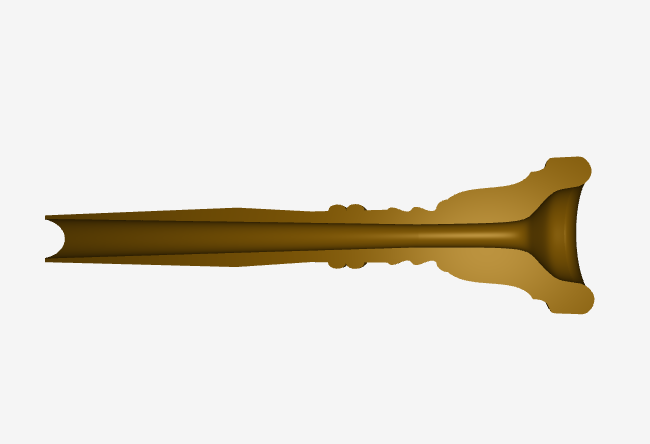
Download your Mouthpiece: The Open Mouthpiece designer
In March, we introduced a free site that offered an online mouthpiece designer.
Introducing: The Open Mouthpiece designer
Introducing an exciting new site that allows you, as a brass instrument player, to design and 3D print a mouthpiece for your instrument, starting from one of the pre-designed models on the site.
PUKKU, pututara, putarino, bucina
Throughout the ancient world, there are many names given to brass instruments which incorporate the pu/bu sound. These are so numerous as to suggest that the confluence of names is more than a coincidence. It may well be that the sound of pu/bu is reminiscent of the blowing of a horn or trumpet or that the shape of the lips when making these sounds mimic the shape when blowing instruments.
Rock Gongs Why do Ringing Rocks Really Ring
When a solid rock is hit by a striker, the area of concussion is compressed by the blow. This compressed section then compresses the neighbouring element further in the rock, the original area returning to its original state. By continuous repetition of this action, a compression wave is created which flows through the rock. These waves are also known as p-waves in seismic studies and are what enable geophysicists to study rock structures both from induced explosions and natural events such as earthquakes. Such waves can travel for enormous distances as is seen when earthquakes are detected on the other side of the world. This points to rocks being able to transmit these waves with relatively small amounts of damping or attenuation taking place within the material which makes up the rock and most of the energy being transmitted and not lost in transit.
Ringing Stones and Rock Gongs
OK, this is a bit of a diversion from brass instruments but, when I was attending a conference many years ago and sat through a really boring presentation, I began thinking about a question a colleague had asked just before a session. She asked me how ringing stones and rock gongs worked so I wrote this. Just a thought or two.
Vikings: Making Brass from Wood - Part 1
Part 1 of 3
Despite their reputation for rape and pillage and the signs of their presence over much of Europe, the evidence for the Viking horns or trumpets comes from their heartland in the western Baltic. It was their settled life as farmers and people just getting on with things which bequeathed us their heritage of wooden instruments: their ancient wooden trumpets. It may seem unfair to saddle these instruments with the prefix ‘wooden’ as the term ‘lur’ was theirs, having first appeared in the Icelandic Sagas. Nevertheless, the term ‘lur’ was taken over by their Bronze-Age predecessors when the archaeologist C. J. Thomsen took over the term luđr from the Sagas. In these tales the lur is frequently mentioned as the instrument by which the warriors are called to battle and the connection of the name to the Bronze-Age instruments must have appeared logical at the time. In the Baltic and Scandinavia, the term also refers to a folk instrument made of wood which was sometimes wrapped with bark and one author, Broholm suggests that the term may originally have referred to a hollow log and, hence to the trumpet . In the town of Ystad the old tradition of the night-watchman’s horn is still carried out in which the town’s night-watchman blows a copper horn which is referred to locally as the kopparlur. In Denmark, in the Jutland dialect, luj is used to describe a shepherd’s instrument made of wooden staves and that children in parts of Jutland make a willow-bark trumpet in the spring which they refer to as a lur. A detailed look at the Viking wooden lur reveals their considerable variety in design, something not seen on the Bronze-Age instruments. The one thing which was consistent on the Vikining instruments was their manufacture by the split/hollow/reseal technique. This involved splitting a piece of wood before hollowing out the interior and then resealing the two halves, securing them mechanically with some binding material. A number of different timbers were used to create these wooden lurs, including willow and hazel. This use of a variety of softwoods contrasts strongly with the Irish practice of around this time and earlier when only Yew was used to create instruments by the split/hollow/reseal method. The bindings were of organic materials, again unlike the Irish horns and trumpets which were bound using bronze strips pinned into the timber of the tubes. Although the binding materials of the Viking wooden lurs were organic, sufficient of these have survived to allow us to identify what they were made of.
Music Archaeology: the Early Days
Music Archaeology: the Early Days
Music archaeology didn’t burst upon the scene. It didn’t even come from one single time or place. Instead it developed over many years, gradually building up to become the multi-faceted study that it is today. While the term music archaeology has been around some time, it was only generally adopted relatively recently but that doesn’t detract from the fact the study of music archaeology has been around for many years before any of its modern adherents were born.
Early Music Archaeology in Ireland and the UK
Early Music Archaeology in Ireland and the UK
The modern story of the Irish Horns started in 1726 with a second edition of Gerard Boate’s book. In this, a section written by Sir Thomas Molyneux was added in which he told of a find where feveral Danifh trumpets of brafs were found buried in the earth, fuch as they ufed in war in thofe times, of a peculiar odd make. Most of the writing of this time and some time later referred to these instruments as war trumpets and of their being of Danish (Viking) origin. He provided dimensioned diagrams of these instruments enabling his readers to get a good idea of the size of these instruments.
Music Archaeology in Scandinavia and the Baltic
Early Music Archaeology in Scandinavia and the Baltic Region
The reported modern story of the bronze lurs begins in Brudevaelte, Denmark in 1797 when a letter dated June 19th 1797, was penned to accompany the first find of lurs on their journey to the Royal Exchequer. Significantly, the six Brudevaelte Lurs were transferred in 1807 to the Royal Art Collection and thence to the newly-established Museum of Antiquities. Thus, from the very beginning, in Denmark, lurs were seen as items to report, treasure and study.
Music Archaeology of the Palaeolithic/Mesolithic/Neolithic
Sounds from Silence: Music Archaeology of the Palaeolithic, Mesolithic and Neolithic
Music Archaeology of the Mediterranean and Middle East
Music Emerging from the Texts
While musical archaeology studies in the Mediterranean area and the Middle East have examined the physical evidence and iconography, written sources have always also played a key role. This was brought into the spotlight when, in the 1970s, Anne Kilmer, an Assyriologist at Berkeley, California deciphered a cuneiform document in the Hurrian language which had been excavated from Ugarit. This she identified as a Bronze-Age hymn which provided evidence of notation based upon a Mesopotamian notation system. Once presented in western notation, this musical excerpt could be heard by modern ears.
Music Archaeology up to the 1960s
Music Archaeology up to the 1960s
Brass instruments underwent monumental changes in the mid nineteenth century with the adoption of valves and one of the workers in the field at the time was Victor-Charles Mahillon, a Belgian musician, instrument builder and writer on musical topics. Coming from a family of instrument makers, he went on to develop many instruments but also created analogues of ancient ones such as the cornua found in Pompeii. He founded and curated the Musée instrumental du Conservatoire Royal de Musique which went on to become the Musical Instrument Museum in Brussels. Such workers added progressively to the knowledge of instruments and were key players in the formation of the discipline known today as music archaeology.
Music Archaeology in Recent Times
What we Learn from our Predecessors
Each generation of music archaeologists enjoys a huge advantage over its predecessor as technological developments offer the opportunity for greater exploration of the material available. However, they also suffer the disadvantage that, as the resource in terms of physical objects, iconography and written materials is, in effect, relatively finite, much of this has been already worked over many times. Of course new material does arise occasionally but its appearance is very rare and somewhat haphazard.
Animisation: Breathing Breath into Brass
The term animisation is used to describe the process where inanimate objects are granted animate powers. In terms of brass instruments, this happens when they look like something animate - a karnyx looks like a serpent; when a horn sounds like the bellow of a bull; when a myth exists which enables them to be perceived as something animate.
When the Brass is Gender Fluid
Ethnographic evidence tells us that gender was attributed to sound tools in various ways, some of these being based only obliquely on the physical characteristics of males and females. In Māori culture, for instance, one instrument, the putorino, possesses the physical attributes of both males and females and is subjected to dual animisation. When blown at its centre, as a flute, it is regarded as a female instrument and when blown at the end, as a trumpet then being seen as male. When accepting this local view of the instrument, the two blowing apertures may be seen as resembling male and female genitalia. However, the big question remains of whether one might interpret them in that way were one not to know how the instrument was seen by its users?
What is a Natural trumpet?
In many ways, the term ’natural trumpet’ is a bit strange as it doesn’t refer to a trumpet which grows in the soil or is dug up from the ground but just one which has no devices on it such as valves or slides or fingerholes. In general, the term has gained most popularity from people who talk about relatively recent instruments, i.e. from the 18th centuries onwards. Renaissance and baroque trumpets are such examples.
What Instruments appear on Coins in the Ancient World?
Coins are an important source of information for music archaeologists. They may be small but the skill of the ancient die maker who makes the two dies which contain the impression of the two sides of the coin was amazing.
When is a Lur not a Lur
When the great, curved Bronze-Age horns were found in Scandinavia and the Baltic Region, no-one knew how old they were or what they might have been called. This was in the days before C. J. Thomsen developed the idea of the three-age system, calling periods, the Stone Age, the Bronze Age and the Iron Age. In those days, things were old, very old and even older, etc.
When did the Trumpet and Keyboard First Get Together?
We can’t say exactly when these two instruments first came to be played together but it certainly didn’t take long after Ktesibios invented the first keyboard instrument. He was a Greek inventor and mathematician who lived in Alexandria, Ptolemaic Egypt. He made all sorts of pumps and similar devices and, among these was the hydraulis or water organ. The ‘water’ bit was because it used water pressure to even out the strokes of the pistons. These were pumped by a couple of boys who had to keep the pressure even or the tune died when too low or everyone got soaked when it was too high. (See my entry 3, What is iconography for another image…)
Enjoying the Craic: The Irish Horns
One of the highlights of the Bronze-Age brass is the Irish Horns, over one hundred instruments which were found all over Ireland. They’ve been turning up for over a hundred years, popping up out of bogs unexpectedly. None have been dug up in organised excavations so we know little about their dating other than that they’re from the late Bronze Age.
Spain’s Unique Iron-Age Brass
Although instruments throughout the Iron-Age world differed, there was considerable similarity both in instrument form and usage. This was not so in the Celto-Iberian cultural area.
When did Brass first Appear in Brass Instruments?
Cast Brass Reproductions of the Pompeii Cornua Support-Bar BossesDespite their name, brass only appeared in brass instruments relatively recently. Throughout the Copper Age, instruments were made from all sorts of metals but principally from copper and precious metals such as silver and gold, as well as the alloy of these two metals, electrum. When tin-bronze came onto the scene, it was widely used as the alloy of choice for instrument construction. Both the late Bronze-Age irish Horns and the Scandinavian/Baltic bronze lurs consumed masses of bronze in their manufacture.
Who Studies Ancient Brass Instruments?
Well, lots of people, really. However, it’s music archaeologists who study all aspects of music in the ancient world. As there have been no direct study courses in music archaeology until very recent times, such scholars who call themselves ‘music archaeologists’ come from very diverse backgrounds. Some arrive from classical studies, some as performance artists, some as craftspersons. Because of this, their work will always have a tendency to reflect where they came from, i.e. to be more concentrated on music or language or whatever.
A Night in the Museum - just me and the Lurs
In June 1975, we set off for our Scandinavian/Baltic tour, my wife and I and two sons. The Copenhagen leg of the tour saw me sitting in a side room off the main gallery in the National Museum, with a selection of bronze lurs. I could handle them, measure them, etc but blowing - not on your life. Strictly verboten! The deal with my family was that I met the three of them at 5.00, when the museum closed, down at the Museum entrance. The lurs are such fascinating beasts that, by the time I looked at my watch, I was a touch surprised to see that it was already 5.30. I rushed out into the main gallery to find it deserted. At the end of the gallery was a huge door, something like a massive security vault door - the gallery did house a large collection of Iron-Age gold, after all. This was the mid 1970s and there were no mobile phones and I could see no way of getting in touch with anyone.
Who Lived in the First Brass Instruments?
The earliest brass instruments which have survived from Europe are the sea-shell trumpets which are often referred to as conch-shell trumpets - although I prefer to call them sea-shell trumpets. They are made from the shells of sea snails which can only grow in warm waters and are found in the Mediterranean and, more-generally, between the 45th parallels to the north and south of the equator.
When were Musical Instruments Not Musical Instruments?
The mention of the word Music will likely bring about a series of mental processes in which you relate the context of the word to your own experiences. Thus, it may be jazz which floods your brain, or classical music, folk music, pop or whatever. Thus if the topic being discussed is based upon ancient practice, the writer must first tear you away from your modern thoughts to transport you back into the ancient world. For this reason, many authors, including myself, often use the term, sound tools to describe objects from the ancient world which might otherwise be called musical instruments.
When did the Cornett(o) earn its Fingerholes?
There’s a couple of answers to this really, depending upon whether you stick to an instrument which had that particular name or whether you mean fingerhole instruments in general. Even today, there are different names used to describe this instrument in the UK and the USA. It hinges on the zero at the end: USA -cornetto, elsewhere - cornett. The instrument which carries the name appeared in the late 1400s but other instruments operating on the same principle are known from somewhat earlier.
What were the Main Structures of Brass in the Ancient World?
It’s easy to think of ancient brass design as following that of modern instruments but that was simply not the case. Granted, there were instruments which had overall structures very much like modern instruments but there were also many which were somewhat different.
When the Air goes Round and Round
Today there are, in the main, just two brass instruments in which the air goes round in circles, the French horn and the Sousaphone although others, such as cornets have, in the past, been made in this way. A little earlier, the cor de chasse (horn of the chase) or trompe de chasse were made in this way and widely used in hunting, as their name implies. It is these instruments which first entered the orchestra. Making an instrument round in this way enabled the player to handle a long instrument more comfortably. Eventually, various devices were added to these instruments to fit them into current ensembles and now they generally have rotary valves to supplement their harmonic series. In the ancient world, it was the Etruscans who appear to have been the first people who chose to wrap their instruments around the player. None of the large instruments which they depicted in their iconography have survived and the only really complete instrument would only really pass a medium-sized. Nevertheless, many of their instruments are large enough to wrap around the player and have a support bar provided which can rest on their player. Their instruments which are depicted are generally conical along their windway but, when the Romans took these on, with the Roman name cornu (plural cornua) they appear to have changed the instrument bores to become cylindrical over most of their length. The evidence for this comes from iconography but also from a set of five cornua which have survived from Pompeii. These cornua have a bore which is conical/cylindrical/conical with a flared bell and are some three and a half metres (about 7 ½ feet long).
What is the Natural Harmonic Series?
This is the range of notes played on any brass instrument when no valves, slides or finger-holes are utilised. It’s terrifically important for ancient and historical brass instruments as it effectively controls what can be played on them.
What did the Greeks use their Trumpets for?
Strangely, the answer is simple, they used their salpinx (that’s what they called their trumpet) for pretty-well everything. From what you read, however, they were principally treated as military instruments. That’s partially true as, for much of the time, neighbouring Greek states were at war with each other. Accounts tell how signals given by the salpinktes, that’s the trumpet player, were used to control troop movements during battles
Spreading Brass on your Toast
The bronze lurs are among the most-characteristic instruments from the Late Bronze Age in northern Europe. They were found in Scandinavia and around the Baltic, the largest number have been found in Denmark.
Why was the letter J popular among Iron-Age Brass Players?
Of course, it wasn’t the letter itself which made its claim of importance to brass players during the long, logo-ago European Iron Ages - between around 1000 BCE to sometime quite a lot later! (probably well over a thousand years). Two instruments with a ‘J’-shape were in use for quite a lot of this time, the lituus and the karnyx (carnyx).
What were the two Tutankhamun Trumpets?
In 1922, British archaeologist, Howard Carter discovered the tomb of Tutankamun, one of the richest ever found. Among the items recovered were two trumpets which, although of the same basic shape as those seen in Egyptian iconography, were quite different from each other. One of the trumpets was of copper or bronze with gold fittings and the other of silver with gold fittings. Each of the instruments has a wooden insert which was still inside the windway at the time of finding.
When did the brass ensemble first appear?
Brass instruments had been around for a very long time before we see different instruments used together. The earliest iconography shows relatively simple ensembles such as that on the Carchemish reliefs where a simple blowing animal horn is shown alongside a large frame drum. This dates from about 1250 BCE.
What’s in a name: Cornu?
The name cornu (plural cornua) appears in Roman literature, describing their instrument which encircled the player. Such instruments are depicted in Etruscan, Roman and native European iconography. The earliest depictions come from Etruscan sources but no large cornua have been found from Etruscan times.
When Louis Met Me
When I started playing the cornet, my two heroes were Louis Armstrong and Eddie Calvert. Louis Armstrong toured Britain in 1956, and I saw an advert in the Derbyshire Times telling about the tour.
The Oldest Brass Instrument?
There’s quite a bit of talk about which is the oldest brass instrument around but, for my money, it terms of continuous tradition, it’s the instruments of the first Australians. Their instrument, which we might refer to as the didgeridoo have many different names among the various groups which play them, one common one being yidaki. It’s not known where the term didgeridoo/didgeridu (UK/Australian spellings) came from but one group, who speak one of the dialects of Rembarrnga, a language spoken now by only a few people in the Roper River region of Australia’s Northern Territory, refer to the instrument as the djalubbu.
Why is iconography relevant?
The term iconography refers to all manner of illustrations and we rely on these to fill in information about instruments when the physical remains are either lacking or fragmentary.
What’s in a name: Lituus?
The term ’lituus’ is one applied to a ‘J’-shaped instrument used by the Romans. Its overall form was very similar to an implement used by the augur, an important person who foretold the future from the flights of birds or the entrails of a sacrificed animal. The instrument has the form of an animal horn attached to a long straight tube. Although we can be fairly certain that the Romans inherited their lituus from the Etruscans, we have no idea what the Etruscans might have called it as they left very few written records behind.
Where did the first mouthpieces appear?
In Scandinavia and the Baltic region, during the late Bronze Age mouthpieces were developed to an astonishing degree. These were seen on the bronze lurs which were probably made between about 1500 BCE and 500 BCE. The mouthpieces were attached permanently to the instruments, being cast at the same time as the instrument itself. What is particularly noteworthy about these mouthpieces is that they show progressive stages of development from a simple lip cushion to what we would today see as fully-developed mouthpieces of a form which we might expect to see on modern instruments. The bronze lurs developed enormously in this area but they are only poorly datable. Archaeologists assess their age on the basis of their decoration when they compare this with that found on other objects which they can date. What we assume to be one of the earliest instruments, one from Gullåkra in Sweden has only a very simple blowing device. It is little more than a turned-over rim which cushions the lips. On the other hand, on what we believe to be later instruments, such as those from Brudevaelte in Denmark, we find mouthpieces which would not feel strange to a modern trombone player. Others of the same age, such as those from Folrisdam, have a much-more conical shape, although they are considerably larger than those one might find on a modern French horn. At the end of the Bronze Age, these mouthpieces disappeared totally and it was some time before the development of the mouthpiece proper began again.
Latest Posts